
Science Teacher of the Year (Middle/Jr. High School): Kristy Cohen
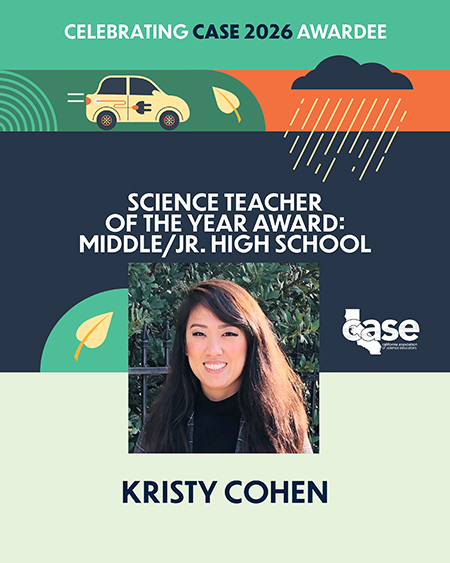
Meet Kristy Cohen
Receiving this award is an overwhelming feeling. It is almost unreal because the science and STEM educational community has been generous, inclusive, and are comprised of so many talented colleagues who are also so deserving of recognition. This award only fuels my passion for bringing science to life for my young scientists in the classroom and beyond in our local environments. This award also is a memorable point in my amazing career to reflect and analyze the effort it takes to create a positive impact on our students and to grow future scientists and engineers. I want to thank specifically all the educators that help me achieve a higher education in the sciences, my professors and mentors who trained me for real and challenging as educator, and my site colleagues and students who remind me of my purpose. Each day in the class has been memorable and meaningful through teaching scientific skills humans will always need.
Can you share the story behind your journey in this field?
My love for science and public education began before I could comprehend the value of knowledge through school or how far education could ever help me reach as a student, teacher, citizen, friend, colleague, and mother. Each of the schools I grew up learning from gave me a community of teachers and classmates who nurtured all my interests in the classroom and beyond. But becoming a teacher was never a point of conversation anyone had with me until I completed my undergraduate students. The first time I recognized learning science was important was when a pre-K teacher took myself and classmates to visit a local fire house and pizza restaurant for the first time - trucks and food really got us. I always felt my time at school, with classmates and teachers, were enriching and allowed me to grow beyond what my imagination could never really bring to life. I always wanted to learn more but knew my limitations were the number of books I had at home or if I would make it in time to watch the Magic School Bus. School always made me feel nervous because I enjoyed being at school and looked forward to all the activities, books, and running around our fields - of course. It took all of my teachers from elementary to high school who allowed me to learn about the life cycle of apples and insects, build a model of the solar system, design an experiment for measuring heat transfer, learning for the first time what molasses was, applying science to better understand our bodies' needs as an athlete, and engineering a house design with trigonometric functions. Don't get me wrong, I loved all my classes, and could be in a math and english class the whole day if possible. Overall, it took our academic counselors and my parents to support my personal interest of various sciences and creating physical and visual models that we saved and crammed into our family condominium. I carried everything I learned about the sciences from K-12 to college and embraced the opportunities to connect the lecture hall, labs, field and professional opportunities together. Long story short, there was not one single aspect of science that I loved more than another so I felt being a science teacher was purposeful for our society and I get to explore the heck out of everything because science rules! It took myself reflecting on the mentorship I received from the educators, not only in science, throughout the challenging and fascinating journey over the years.
What’s one lesson you’ve learned that you’d share with others?
One lesson I have learned as a science educator is the career is always evolving and there really are no limitations to what a science teacher can do, whether in the classroom, community, out in the field, and one day we will get more teachers and students into space. When we bring learning experiences into the classroom for our students or bringing them out of the classroom, we are helping our students connect to Earth's and our human history as the build their own history for themselves in real time. The students deserve an opportunity to experience that history with you and in our classrooms through vital connections with one another.
What advice would you give to someone just starting out in science education?
Every child who walks into your classroom loves or wants to love science. Embrace the discovery of growing your professional and personal self along with your students. Trust what you love most about science, the cool lab activities, fun facts, deep thinking, and connections are what students love just as much as you. On a more technical note, I do want to say through the literature behind learning and science education, the quote that stood out most to be over my career is, in the classroom "there is no inquiry without classroom management." :)
What's next for you?
Is it too boring to say I plan on sticking around for as long as I can until a former students comes looking to take my job? It is true, I would love to stay in science education for as long as possible. Even now through leadership roles through teacher mentorship and collaboration on various projects for students, I could never give up being an educator of the sciences for the youth. I would love to see myself back in the classroom as a student amongst younger, same -aged or older peers and give back in the form of research - since education research has been the best support and help as having educator mentors. Lastly, I would love to give back in the form of special programs that support teachers and students in the classroom and out in the community.
What excites you most about the future of science education?
What excites me most about the future of science education is the growth in the community and the amount of opportunities there are for science teachers and our students. Science education may not have been formally established for as long as education in other subjects, such as the arts. But that is because we are establishing the culture and expectations for science education now. As science education continues, I would love to see our subject area as more of a integration point for culture and all other school subjects so that there is a clear predictor of what STEM skills may lead to future careers and endeavors. In addition to leadership roles based on scientific considerations. I feel we can do a lot through science in our schools and it would be grand to have more time to do so for our youth.
What is your favorite book/podcast right now?
Sherlock Holmes... because that is what my 3 year old wants me to read to her.
What is the word that best describes you and why?
Committed - This word best describes me because I never start projects I cannot finish and have a realistic view of what I can achieve and who I may affect. Personal emotions do not affect my performance as an educator (99% of the time). I am committed as a team member and individual to my profession and personal interests. Together I think that is what has helped me engage with my students and colleagues over time as a science educator. Additionally, I do not love to leave anyone behind and refuse to give up on most adventures. If I had another term to add to committed, it would be consistently committed because my coworkers have given me fun awards such as Captain Marvel or Constant Velocity Award.
Do you have a hidden talent? Tell us about it!
I make some fun themed charcuterie boards that my family and friends always love. I use to have more talents during my time as a younger science teacher.
Upcoming Conferences
- 2026 Conference
November 6-8, 2026
Sacramento, CA
Sacramento Convention Center - 2027 Conference
October 8-10, 2027
Pasadena, CA
Pasadena Convention Center

Quick Links
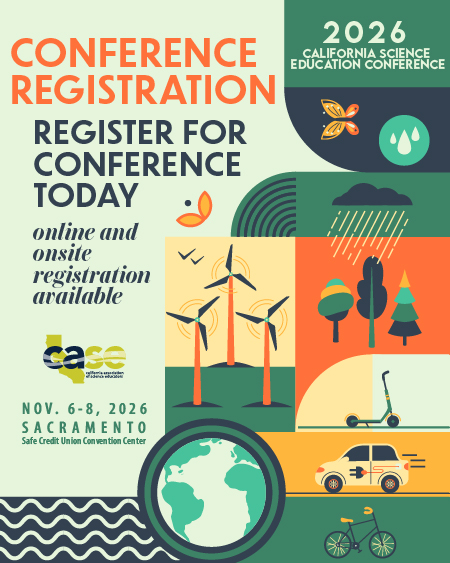
Conference Registration Open
- Full Price (10/1 through Conference)
- If you have already registered and need to purchase ELAD or Conference Add-Ons (BEGIN HERE)