
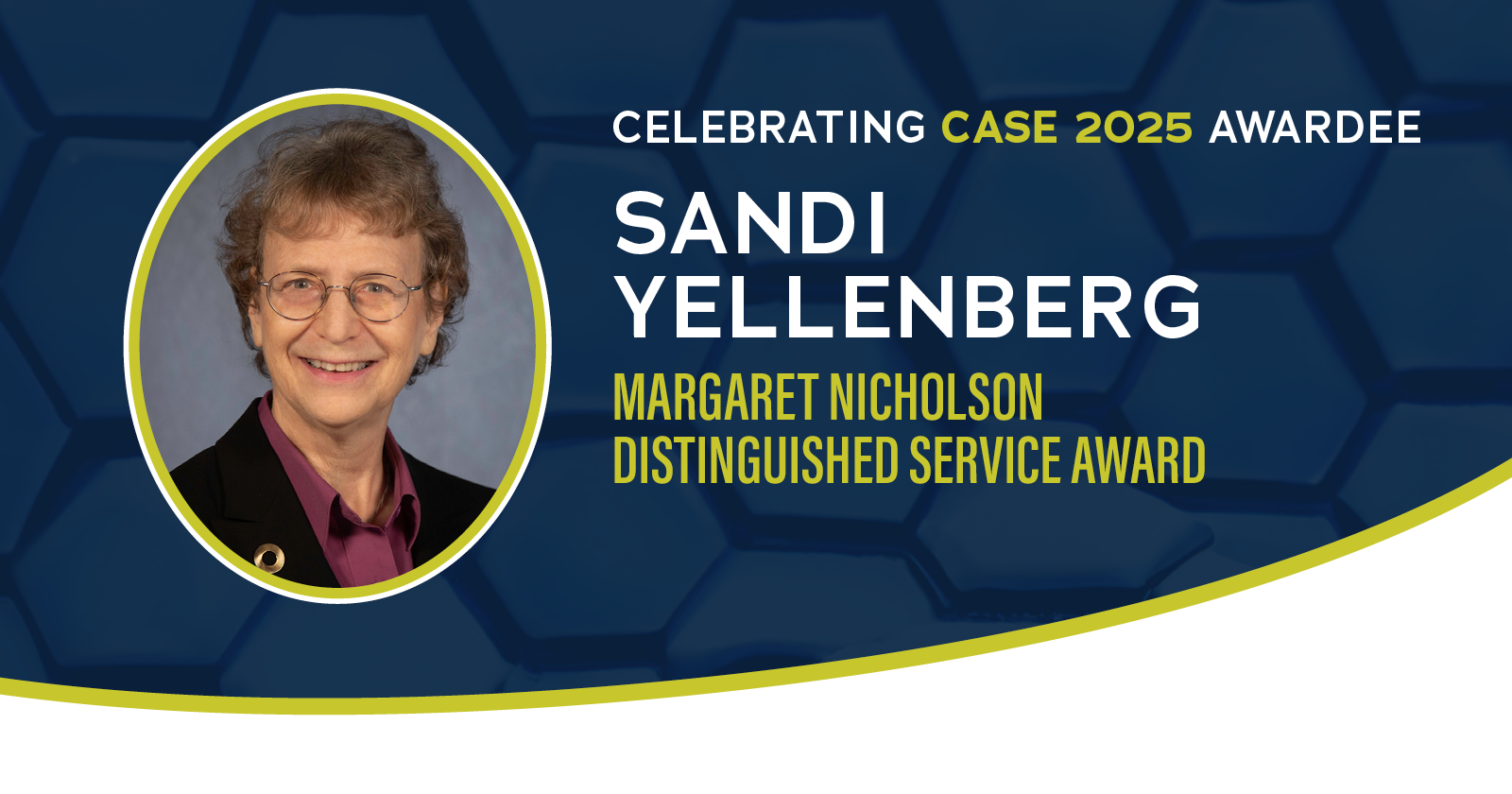
Margaret Nicholson Distinguished Service Award: Sandi Yellenberg
Meet Sandi Yellenberg
My path to becoming a science educator was not a well-planned journey.
After earning my biology degree, I sought research positions but found few due to government funding cuts. Instead, I began my career in health insurance before leaving several years later to start my family, thus concluding my first chapter of employment.
Following the birth of my second child, I leveraged my love and knowledge of music to start my second career as a preschool music teacher, which later led to a third career, entertaining at children's birthday parties.
After six years teaching preschool music, I obtained part-time positions as a K-5 music and science lab instructor, teaching music two days a week and science three. Based on colleagues' recommendations, I returned to school to earn my teaching credential and started my fourth career as a certified teacher.
I began as an elementary teacher and was later promoted to the district's K-8 Science Mentor Teacher, while also earning a master’s in educational leadership with a preliminary Administrative Credential.
With these new qualifications, I became Science Coordinator at the Santa Clara County Office of Education, where I served on California’s Curriculum and Instruction Steering Committee (CISC), partnered with organizations including K-12 Alliance and West-Ed, secured grants supporting science teacher training, led conference workshops, and assisted teachers, administrators, and the county’s science fair.
My lessons learned are- be open to:
developing a broad skill set
accepting diverse opportunities
exercising diligence in all professional capacities
appreciating the inherent unpredictability of career progressions
What advice would you give to someone just starting out in science education?
My guidance for individuals beginning their careers in science education is as follows:
- Recognize that no one knows everything; it is not expected that you will know everything either.
- Proactively seek out information relevant to your responsibilities to enhance your effectiveness. (A mentor or friendly co-worker can be helpful with this.)
- Dedicate the initial weeks of the school year to establishing classroom expectations. Clearly communicate rules, model appropriate behaviors, and consistently hold students accountable.
- Teach students respectful behavior and how to self-regulate. That is a critical part of your role as an educator.
- Demonstrate the relevance of a lesson’s content by illustrating how the concepts apply to students’ lives, future professions, or post-secondary pathways.
- Talk to students expressing boredom. Sometimes the real issue is that they don’t understand the assignment. If the conversation demonstrates that they’ve mastered the assignment, consider ways to differentiate it for them.
- Periodically, ask students who have just provided a correct answer, “Why?”, prompting them to explain the evidence for their reasoning. This practice uncovers whether the response is based on comprehension, memorization, or guessing. Articulating the reasoning in class can help all students deepen their understanding.
- Teaching isn’t about achieving perfection; it’s about constant improvement.
What excites you most about the future of science education?
I'm excited about two aspects of science education’s future. One is the impact of technology, which enables students to explore scientific concepts beyond previous limitations. Currently, portable computerized microscopes allow students to observe small details and measure the size of what they are viewing. Cameras on students’ phones can make slow-motion recordings, facilitating more in-depth analysis of what they are studying. Google Earth provides opportunities to examine satellite images of geological formations from multiple angles, and not just from a single image in a textbook. In the future, students will likely have greater access to data and research tools. Satellites may permit real-time information. Programs created with AI may support virtual trials of student designed experiments. Students will be empowered to discover more evidence-based answers to their questions and address complex challenges more effectively.
The second area is more personal. Participants from my past trainings report that they continued to use and adapt ideas from my presentations. I’m honored and excited to know that certain practices continue to be used to help train future science educators to provide engaging and effective science education for students.
What is the word that best describes you and why?
I don’t believe that people should be described in only one word, so I’ll give you 5:
- I’m energetic.
- I’m passionate about science.
- I’m inquisitive. (I have a drive to find the best possible solution to problems and to find out how things work.)
- I can be creative when solving problems (another way of saying I think outside the box – sometimes way outside).
- I also try to be thoughtful, both in relationships with people and in making any work I do meet the needs of the learners I’m working with.
Upcoming Conferences
- 2026 Conference
November 6-8, 2026
Sacramento, CA
Sacramento Convention Center - 2027 Conference
October 8-10, 2027
Pasadena, CA
Pasadena Convention Center

Quick Links
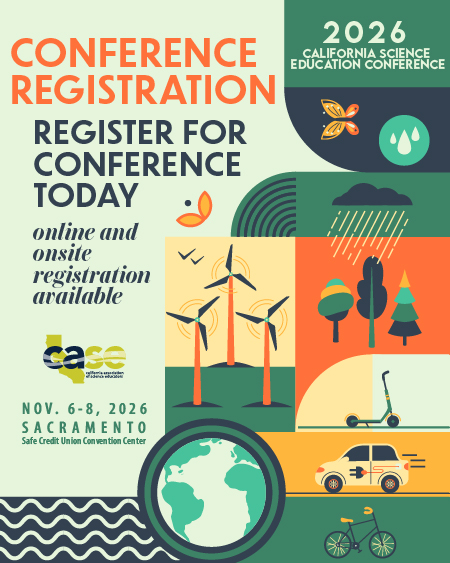
Conference Registration Open
- Full Price (10/1 through Conference)
- If you have already registered and need to purchase ELAD or Conference Add-Ons (BEGIN HERE)