
Teacher of the Year (High School): Kevin Myron
Meet Kevin Myron
In my first year of teaching, I was assigned to 9th grade Earth Science, even though I had entered the profession determined to teach biology. At first, I did not view it as an exciting assignment. But as I began redesigning the course with a colleague, we centered each unit on real-world environmental issues in San Diego. Students examined the impacts of urban heat islands in their neighborhoods, explored water quality through hands-on labs, and used fluorescent dye to find microplastics in commercial shrimp. What began as a placement outside my comfort zone became the foundation of my teaching identity.
That same year, my AP Environmental Science students began asking hard questions: “Why does our own campus not reflect the sustainability practices we are learning about?” and “Are we going to learn more about indigenous ecological knowledge?” Their voices sparked my own journey into learning, advocacy and schoolwide change. Students and staff organized a task force and presented proposals to our governing board, which passed a unanimous resolution establishing a staff Sustainability Coordinator role. From there, students worked alongside me to create a comprehensive Sustainability Action Plan, engaging peers, staff, and community partners to propose initiatives for energy reduction, waste management, and green infrastructure.
My journey since then has been defined by openness to learning and unlearning, letting students’ questions and ideas guide me toward making science education more relevant, just, and empowering. Their advocacy not only deepened my teaching but also showed me the power of linking classroom learning to real institutional transformation.

What advice would you give to someone just starting out in science education?
In your first years of teaching, be open to new labs, topics, and even whole courses. I left my credential program set on teaching biology. When I was assigned 9th grade Earth Science, I initially saw it as a detour. Yet that course became the most transformative part of my career. It taught me that some of the best opportunities come from unexpected directions.
Lean into experimentation, not just in labs but in your own practice. Try new strategies, co-create with students, and do not be afraid to redesign lessons around local issues that matter to them. Shifting from a traditional concept-driven course to one rooted in environmental phenomena with NGSS reinvigorated my teaching and made learning more meaningful for students.Most importantly, listen deeply to your students. Their questions often reveal gaps in our own perspectives. Being willing to adapt, reflect, and grow alongside them will not only strengthen your teaching but also help students feel seen and empowered.
What excites you most about the future of science education?
I am most excited by the growth of the green schools movement and its potential to transform campuses into living laboratories. Schools consume significant resources and leave a sizable ecological footprint, but that also means they are uniquely positioned to model sustainability in action. Imagine students tracking their own school’s energy use, managing waste systems, or designing green infrastructure on campus while connecting those experiences directly to science learning.
This kind of experiential, justice-centered education fosters climate literacy while preparing students with the problem-solving skills they will need in an uncertain future.
I also see an important shift toward embedding equity and justice into science education phenomena. From incorporating Indigenous ecological knowledge to grounding lessons in students’ local contexts, we are broadening whose voices and experiences shape science. That excites me because the challenges ahead demand creativity, inclusivity, and leadership from all students, not just those who choose advanced science courses. The future of science education lies in preparing every student to be both scientifically literate, civically engaged, and equipped with the tools to lead change no matter their career field.
What is your favorite book/podcast right now?
Recently I read Playground by Richard Powers, which explores how an island community previously impacted by colonization decides whether or not to allow another wave of external influence. AI also makes its way into the book. By the end, you’re rethinking it all, but I won’t spoil it!
Upcoming Conferences
- 2026 Conference
November 6-8, 2026
Sacramento, CA
Sacramento Convention Center - 2027 Conference
October 8-10, 2027
Pasadena, CA
Pasadena Convention Center

Quick Links
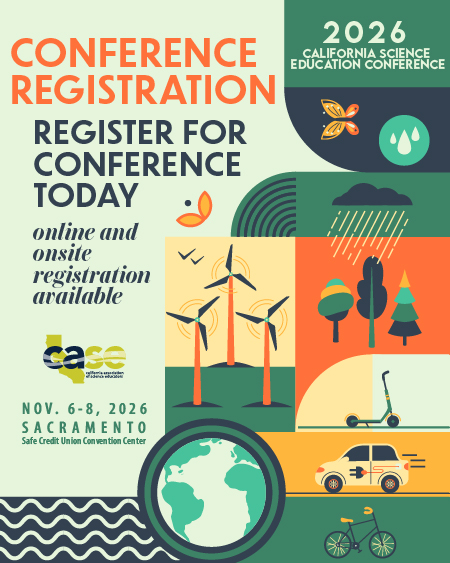
Conference Registration Open
- Full Price (10/1 through Conference)
- If you have already registered and need to purchase ELAD or Conference Add-Ons (BEGIN HERE)